I've been looking for classics book bloggers since I started blogging myself, and . . . they're hard to find! But I HAVE FOUND MY PEOPLE!
The Classics Club is a consortium of bloggers joining together to share their experiences reading the classics. Which, you know . . . is a thing I do! And all one needs to do to join them is come up with a list of 50 classics you plan to read in at most the next five years. So. I am joining, and I am SO excited. Book blogging is much more fun when it includes other book bloggers.
I have hundreds of classics on my life list, but for the purposes of the classics club, I narrowed it down to what I am most interested in reading with the next few years.
Without further ado, my list:
Showing posts with label classics. Show all posts
Showing posts with label classics. Show all posts
3.09.2015

3.06.2015
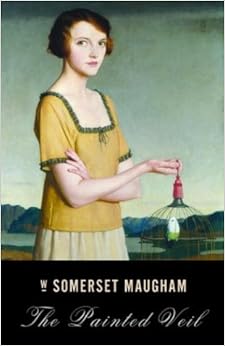
The Painted Veil, by W. Somerset Maugham
Anyway.
The Painted Veil follows Kitty Fane, a young English socialite who marries unwisely for selfish reasons, moves to Hong Kong with her husband, proceeds to have an affair with a rather odious man, and is found out (this all happens very early in the book; no spoilers).
Kitty's husband, Walter, is rather a tortured soul and wishes death on both himself and his wife, which he decides to accomplish by “heroically” dragging Kitty into the epicenter of a cholera outbreak (he is an MD specializing in bacteriology). There he proceeds to fight cholera and be tortured by his soul, while Kitty proceeds to have some very interesting spiritual and emotional growth.
I've read a few books about adultery; Madame Bovary and Anna Karenina spring to mind. I thought the handling of it here was much more interesting than either (though I'd say Anna Karenina is the greater novel overall).
Neither Emma nor Anna really learns much from their affairs. Their experiences just pull them deeper and deeper into all sorts of misery. Both of them end (SARCASTIC SPOILER ALERT FOR HUNDRED YEAR OLD BOOKS!) by dramatically killing themselves. Because DEATH is the price of a woman's transgressive sexuality!
Not for Kitty Fane, bless her heart and the heart of Somerset Maugham.
2.13.2015
Rebecca, by Daphne duMaurier
I expected to like and enjoy this book; I did not at all expect the passion I ended up feeling for this book. I stayed up until 1 am on a worknight unable to put it down! The next night I binge-watched the BBC mini-series! This book was a ridiculous amount of fun to read, the prose was excellent, and the author held together what should have been (well, which kind of is) a ridiculous plot with amazing aplomb, pulling off some special effects along the way.
Here's the basic deal with Rebecca (non-spoiler paragraph to come; all of this you can get from the back cover or the first few pages): Young innocent girl falls in love with billionaire (well, this is Britain between the wars, so not billionaire but landed gentry) Maxim DeWinter, who has a Tragic Past: his wife, Rebecca, died just a year ago. He meets our ingenue (who remains unnamed throughout the book), marries her, and carries her off to his ancestral home, Manderly, where our heroine has to make sense of the past.
It's a classic gothic romance that more than lives up to expectations. It can be read and enjoyed even by those who have zero interest in gothic romances. I don't want to try to tell you about my love for this book while trying to hide what happens, so: spoilers behind the cut!
If you don't want to read it, there is a BBC miniseries starring Jeremy Brett (swoon) that I have now also watched. It hews very closely to the text, almost all of the dialogue being lifted straight from the book. Recommended!
Spoilers away!
Here's the basic deal with Rebecca (non-spoiler paragraph to come; all of this you can get from the back cover or the first few pages): Young innocent girl falls in love with billionaire (well, this is Britain between the wars, so not billionaire but landed gentry) Maxim DeWinter, who has a Tragic Past: his wife, Rebecca, died just a year ago. He meets our ingenue (who remains unnamed throughout the book), marries her, and carries her off to his ancestral home, Manderly, where our heroine has to make sense of the past.
It's a classic gothic romance that more than lives up to expectations. It can be read and enjoyed even by those who have zero interest in gothic romances. I don't want to try to tell you about my love for this book while trying to hide what happens, so: spoilers behind the cut!
If you don't want to read it, there is a BBC miniseries starring Jeremy Brett (swoon) that I have now also watched. It hews very closely to the text, almost all of the dialogue being lifted straight from the book. Recommended!
Spoilers away!
1.23.2015
Franny and Zooey, by Salinger (book review)

Upon finishing this book, I was immediately seized by Book Evangelism. I wanted everyone in my life to know how amazing this book was, and I took to Goodreads to find out who else had read it, who else had loved it, and who was just waiting to be converted.
I was in that blissed-out trance state of Book Infatuation and it was inconceivable to me that — wait for it — perhaps not everyone liked this book.
Until I realized one of my friends hated it. She didn't put it on her "books to be hurled from me at great velocity" Goodreads list (a list title which, God help me, I now dearly wish to copy), but she one-starred it, which is the Goodreads equivalent of a death wish (the same rating I gave to Zen and the Art of Motorcycle Maintenance, for the record).
Honestly, though, I can see why someone might fairly hate this book.
It is billed as a short story and a novella, but it's not, not really. It's a morality play, or a parable, or possibly a religious text. So if you want actual plot, I have to say this falls a bit short.
I found the Glass family (the two main characters are sister and brother, Franny and Zooey Glass) to be rather precious and unbelievable as well. It is a family with seven extraordinarily precocious children who go about doing things like starring in child trivia competitions and memorizing Epicictus. Also they speak in italics all the damn time. It's annoying as hell, godamit.
The whole lot of them would fit right into a Wes Anderson movie. In fact, this whole book reminded me vividly of a Wes Anderson movie. And if you hate Wes Anderson movies, well, it's hard to blame you (though I, personally, enjoyed The Grand Budapest Hotel very much, thank you.)
The whole lot of them would fit right into a Wes Anderson movie. In fact, this whole book reminded me vividly of a Wes Anderson movie. And if you hate Wes Anderson movies, well, it's hard to blame you (though I, personally, enjoyed The Grand Budapest Hotel very much, thank you.)
All that said: I loved this book.
Subscribe to:
Posts (Atom)