Showing posts with label poetry. Show all posts

3.06.2015

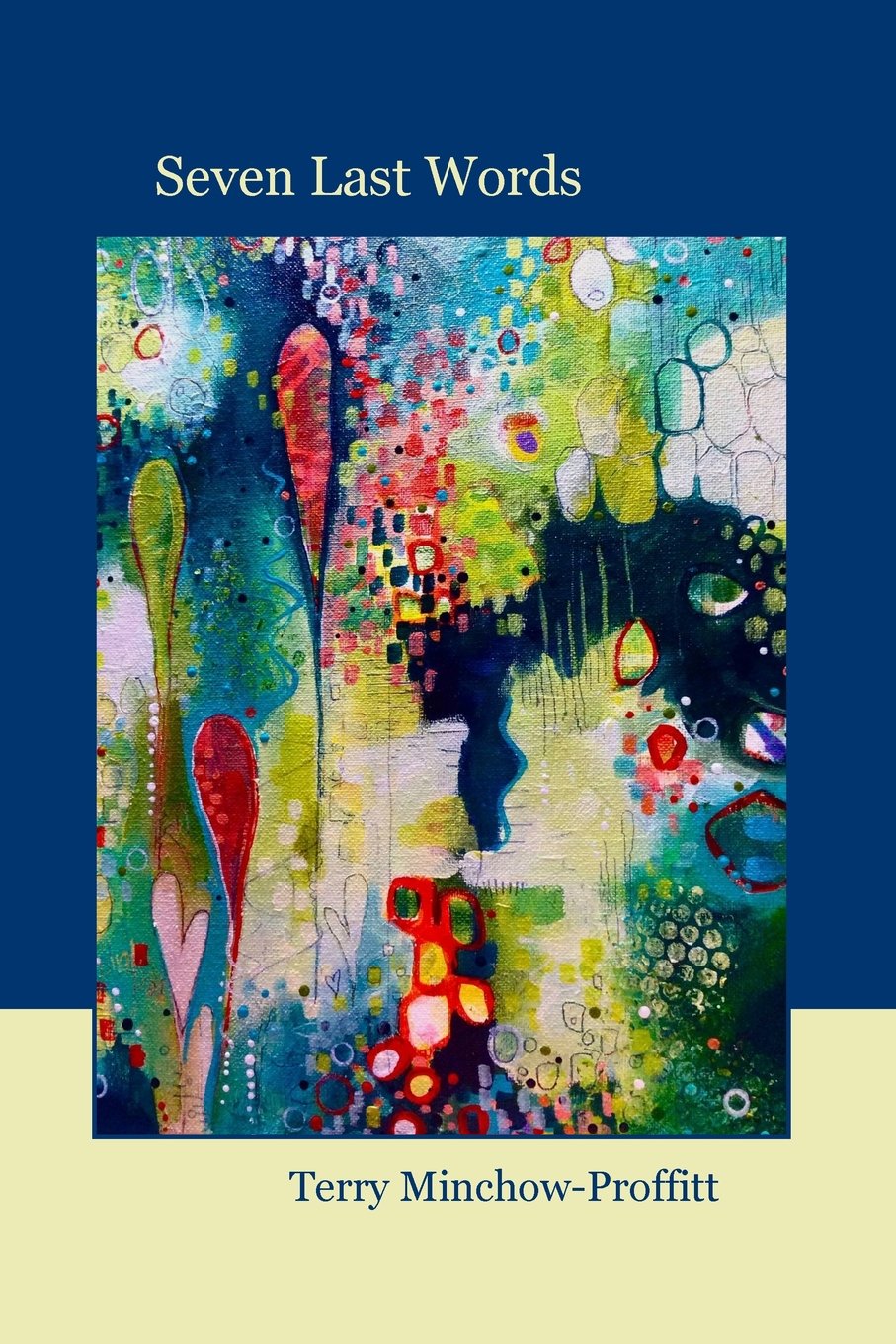
Seven Last Words, by Terry Minchow-Proffitt

In the interests of full disclosure, I'm biased about this book. Mud Season Review published this poetry while I was poetry editor there; I blurbed the book for Terry; he kindly sent me a copy as a gift.

I'm not sure if all that means that I am likely to not tell the truth about the book, though. I mean . . . I published the poems! I blurbed the book! I am SO EXCITED about this work!

I really like poetry that takes up religious themes (I should, given my current editing position . . .), but I am damn picky about my religious poetry. I don't like abstractions. I don't like schmaltz (well, I like schmaltz, but not in this context). I don't like thinly veiled theological polemics. I don't like trite answers.

This poetry is none of those things. Rather, it presents a cycle of seven poems, each of which meditates on one of the Seven Last Words of Christ as he died. These may be found here, where they were first published at MSR. (Go ahead and read the poems there, but don't hesitate to buy the chapbook too if you like them, as it includes extra material, like an extended author interview, a forward, and an afterward. Also the artwork is bound up with them, which is great!)

1.26.2015

Citizen: An American Lyric, by Claudia Rankine (book review)

Citizen: An American Lyric, by Claudia Rankine 


Read this book.

Okay, that's not going to be my entire blog post on this book, but it could be.

Citizen is a book-length poem about racism, both micro- and macro-aggressions, in America. It is written primarily in the second person, and is actually the first book-length work I have read in the second person (No, I haven't read Bright Lights, Big City.) The use of the second person was remarkably compelling to me. I knew it was written in the second person before I picked it up, and was worried it might come across as "gimmicky" to me, or even annoying. It didn't. It was gripping and helped propel me through the narrative.

Until I read Citizen, not only had I never read in the second person, I had also rarely (ever?) read a volume of modern poetry as a coherent entity (of course I have read epic poetry like that — my obsession with The Divine Comedy is a topic for another day!). I have been reading all modern poetry collections as if they were anthologies, dipping in and out, never reading straight through.

Citizen is not meant to be read that way. The work is not clearly separated into different poems with titles that can be easily excerpted (though part of it was published in "Poetry" in March 2014 and can be found here; please, please, at least check this out to see if you could be into the full work), but each section of poetry is set off by whitespace and sometimes imagery.

Rankine has amazing range as a poet. She seems to effortlessly turn from a stream-of-consciousness style (as in the excerpt I linked) to a more abstract style, sort of Jackson Pollock poetry; at times she is working more towards effect than towards meaning. (I am sure there is a name for this style of poetry; can any blog readers out there help me out? Is it just modernism?)

Stylistically, the closest thing to Citizen that I have read is probably Ulysses, which I am reading right now. Both works use dialogue, stream of consciousness, and words-for-their-effects. Both Joyce and Rankine turn almost effortlessly from one voice to another. (Lest my comparison to Ulysses turn you away, I will reassure you that Rankine is much more readable than Joyce. Also, Citizen is only 160 pages long, with fairly large print and pictures. Ulysses, let me assure you, has no pictures.)

Is this my favorite style of writing? No. No, it isn't. But Rankine is so very, very good at it that I actually don't care. In a totally-not-at-all sort of way (they are entirely different poets) my reaction to her reminds me of my reaction to Sylvia Plath: not at all my type of poetry, but omigod you are so good at this. 

I've been reading a lot about racism recently (like lots of people in America right now), and this is hands down the best thing I've read, both in terms of compelling me and in terms of sheer artistic virtuosity.

Read this book. 


7.01.2012

Sunday Poetry: A Noiseless Patient Spider


A noiseless patient spider,
I mark’d where on a little promontory it stood isolated, 
Markd how to explore the vacant, vast surrounding, 
It launched forth filament, filament, filament, out of itself.
Ever unreeling them, ever tirelessly speeding them.


And you O my soul where you stand, 
Surrounded, detatched, in measureless oceans of space,
Ceaselessly musing, venturing, throwing, seeking the spheres to connect them. 
Till the bridge you will need be formd, till the ductile anchor hold, 
Till the gossamer thread you fling catch somewhere, O my soul.

—Walt Whitman

6.24.2012

Poetry Sundays: Holy Sonnet VII

Why Sunday poetry? Because I decided to switch from Tuesday poetry, that’s why!


Holy Sonnet VII
John Donne

At the round earths imagined corners blow
Your trumpets, angels, and arise, arise
From death, you numberless infinities
Of souls, and to your scattered bodies go;
All whom the flood did, and fire shall oerthrow,
All whom war, dearth, age, agues, tyrannies,
Despair, law, chance hath slain, and you, whose eyes
Shall behold God, and never taste deaths woe.
But let them sleep, Lord, and me mourn a space;
For, if above all these my sins abound,
‘Tis late to ask abundance of Thy grace,
When we are there. Here on this lowly ground,
Teach me how to repent, for thats as good
As if Thou hadst seald my pardon with Thy blood. 

6.20.2012

God and Images of Rape in Jeremiah

I rarely feel alienated by gender-exclusive language. I am comfortable reading ‘man,’  ‘mankind,’  ‘he,’  ‘his,’ etc. as inclusive of me, a woman. (I feel similarly when reading novels with predominantly male characters.) I don’t know why I feel this way (I could speculate) and I certainly don’t draw any ideological conclusions from this; it’s just the way I am. Overall, I am rarely aware of my gender while reading.

Sometimes, though, I approach a passage and am suddenly very aware of my gender, and how my gender alters my reading of the text.

Let us consider Jeremiah 20:7.

My handy ESV (if you doubted that I was comfortable with gender exclusive language, the fact that I predominantly use an ESV should convince you, although I really own it because it was the most convenient wide-margin Bible I could find) renders this verse,

“O Lord, you have deceived me,
and I was deceived;
you are stronger than I,
and you have prevailed.”

I can’t get much useful meaning out of the first two lines; I’ve never experienced God as a deception. The second two lines strike me as even less useful. Yes, God is stronger than mortals. Is this news? Nevertheless, it’s inoffensive.

I’m reading Rabbi Abraham Joshua Heschel’s The Prophets, and he makes an entirely  convincing argument that the proper rendering of the verse is,

“O Lord, Thou hast seduced me,
And I am seduced;
Thou hast raped me
And I am overcome.”

That makes, theologically, a heck of a lot more sense. It’s much more powerful language. I get it. It ‘opens’ the verse for me, and gives me a new perspective on the prophetic experience. Here’s Heschel:
“This interpretation betrays an ambivalence in the prophet’s understanding of his own experience. The call to be a prophet is more than an invitation. It is first of all a feeling of being enticed, of acquiescence or willing surrender. But this winsome feeling is only one aspect of the experience. The other aspect is a sense of being ravished or carried away by violence, of yielding to overpowering force against one’s will. The prophet feels both the attraction and the coercion of God, the appeal and the pressure, the charm and the stress. He is conscious of both voluntary identification and forced capitulation.”

Yes. Absolutely, yes. That speaks to my experience of God. I have felt coerced, enthralled, overcome. There is appeal and pressure, charm and stress. “All your waves and your billows have gone over me!”

And yet.

As a woman, the image of God as rapist gives me the heebie-jeebies. Surely I cannot be the only person to feel likewise—hence, presumably, the more neutral rendering of even a conservative, literal translation like the ESV. I can get over my distaste, but just barely, and I’ve never been sexually assaulted. I imagine this translation would be much more problematic for someone who has. Yes, the prophet is speaking about a loving coercion—but rape is never loving; rape is terrifying and horrible. Yes, part of the prophet’s point is that a genuine experience of God can include fear—but that is fear caused by the prophet’s human experience of an overwhelming Divine, not fear caused by a woman’s victimization. Yes, I see the point, and find the metaphor useful—but it still makes my stomach squirm.

I find myself very interested when I notice my gender intersecting with my reading of a text. (I am assuming that women are more likely to be uncomfortable with this passage than men; perhaps that is a false assumption.) Ultimately, despite my qualms, I find this rendering of the passage useful and compelling—and I wonder what that says about me and my approach to the Bible.

I wonder if I would find this passage equally useful without my queasiness. (I felt similarly queasy all the way through Lolita, and know I wouldn’t remember that book so vividly or find it so compelling without its ability to induce a vague nausea.) I wonder where the line is between language that provokes us into deeper thought, and language that is simply offensive—language that pushes our limits, and language that is too far outside of them for us to follow.

While reading this passage of Heschel, I couldn’t stop thinking about Donne. One of his Holy Sonnets uses very similar imagery to convey a slightly different, but related, point. I don’t feel any queasiness about this sonnet. I love it whole-heartedly:
Batter my heart, three person'd God, for you
As yet but knock, breathe, shine, and seek to mend;
That I may rise and stand, o'erthrow me, and bend
Your force to break, blow, burn, and make me new.
I, like an usurp'd town to another due,
Labor to admit you, but oh, to no end;
Reason, your viceroy in me, me should defend,
But is captiv'd, and proves weak or untrue.
Yet dearly I love you, and would be lov'd fain,
But am betroth'd unto your enemy;
Divorce me, untie or break that knot again,
Take me to you, imprison me, for I,
Except you enthrall me, never shall be free,
Nor ever chaste, except you ravish me. 
I’m not entirely sure why I find this language less problematic than the language in Jeremiah. Part of it is because this speaker is much more clearly longing to be overcome. Part of it is that ‘ravishment’ is part of a whole spectrum of forceful imagery (batter, break, blow, burn, imprison, enthrall), not the predominant image. Part of it is simply that I love Donne and, in a weird way, ‘trust’ him more than I trust the author of Jeremiah. Part of it is that the word ‘ravish’ has a whole different range of connotation for a modern reader than the word ‘rape’ does.

When, if at all, is it ever acceptable for a writer to use images of rape in this way? Does it change depending on the gender of the author? Does it change depending on the context they were writing in?

How do others notice their gender identity affecting their reading of the Bible?
6.19.2012

Poetry Tuesdays

Tuesdays are for poetry. Why? Because every day is for poetry.

I had no time to hate, because
The grave would hinder me,
And life was not so ample!
Could finish enmity.

Nor had I time to love; but since
Some industry must be,
The little toil of love, I thought,
Was large enough for me.

—Emily Dickinson

6.12.2012

Poetry Tuesdays: Spring and Fall

Tuesdays are for posting public domain poetry. Why? Why not?

In reference to this poem I could go on about the recurrence of falling leaves as a symbol of death in Western literature, or the biblical allusion in lines 12–13 . . . but instead I will say that the last two lines send chills down my spine. Every time.

Spring And Fall: To a young child
Gerard Manley Hopkins

Margaret, are you grieving
Over Goldengrove unleaving?
Leaves, like the things of man, you
With your fresh thoughts care for, can you?
Ah! as the heart grows older
It will come to such sights colder
By and by, nor spare a sigh
Though worlds of wanwood leafmeal lie;
And yet you will weep and know why.
Now no matter, child, the name:
Sorrow's springs are the same.
No mouth had, no nor mind, expressed
What heart heard of, ghost guessed:
It is the blight man was born for,
It is Margaret you mourn for.

5.20.2012

Lessons from the 6th World Conference of Friends: Spiritual Humility, Spiritual Gifts

Let me tell you about the Young Friends Epistle. The Epistle That Wasn't. The Zombie Epistle (there was substance, but no life).

The Young Friends at the World Conference (Young Adult Friends, for you NEYMers) were invited by the larger gathering to write an epistle. In response, we formed a small committee to write the thing and bring it back to our business meeting for revision and approval. I offered to record for that business session. When the epistle arrived, it was clear that the meeting wanted something more substantial than the letter we had been presented with. During the first business session we sat for four hours. There was some real worship with moving ministry arising out of it, and we felt we were very close to unity. 
Young (Adult) Friends at the
World Conference

During the second session we sat for two hours and fell apart. We were not in worship; we argued; at the last minute (when I thought we were close to approval despite it all) there was a sudden wall of resistance and we agreed not to have an epistle at all (I can't say we were "clear," because at that point there was not any gathered sense of the meeting). 

Those are the facts, more or less.

After it was obvious that we were Done Writing An Epistle, I felt all sorts of things. Relief, primarily: recording can be arduous at the best of times, and this was some of the most difficult recording I have ever done. Then, sadness. Pain. A sense of "What-could-I-have-done-better?" A desire to move on, accept that it wasn't going to happen,  let it go --- and simultaneously, a desire to hold on, to not let all of that work and worship and striving be wasted.

After that last painful business session, part of me wanted to scream, but my task was to say, "I was faithful to the Spirit; this much I know is true. Now my role is done; now I must step away."

On the last epistle I was exercised to help write, we had come to an easy unity. Therefore I had not noticed how I stepped away. I had done so seamlessly, painlessly, because the work came to its natural fulfillment. On this epistle, the work was cut off. Stepping away was hard and painful and I didn't do it perfectly --- but I did it. Because it was hard, I noticed it. Because I noticed it, I have been able to see my struggle of letting go as part of the ministry --- not a sad, amputated stump.

The exercise of many gifts --- of any creative gift --- requires an act of stepping away. Learning to step away is what releases the poem or the painting or the epistle into the world, to have life independently of its creator. Quakers talk about "laying down" a ministry. I've learned that each act of ministry must be "laid down," or it never takes root. 

I have sometimes thought that spiritual humility required downplaying my ministry. I have been wrong; that is a form of pride. Acknowledging one has a gift, faithfully using it, laying it down as called, and being clear that the fruits of that gift are not from oneself, but from God --- that takes much more humility than downplaying a gift or keeping it under a bushel.  Granted, if one does the latter, one never has to grapple with these issues!

(My favorite bit ever written about spiritual pride comes from The Screwtape Letters, where one demon is giving advice to another demon on temptation: "Your patient has become humble; have you drawn his attention to the fact? All virtues are less formidable to us once the man is aware that he has them, but this is specially true of humility.  Catch him at the moment when he is really poor in spirit and smuggle into his mind the gratifying reflection, 'By jove! I'm being humble,' and almost immediately pride --- pride at his own humility --- will appear.  If he awakes to the danger and tries to smother this new form of pride, make him proud of the attempt --- and so on, through as many stages as you please.  But don't try this too long, for fear you awake his sense of humour and proportion, in which case he will merely laugh at you and go to bed.")

Another thing.

Honestly, in my struggle to be humble (which plays out very much like the scenario above!), I tell myself all sorts of really crazy things.  Here's one of my favorites: "This is not you, but God through you.  Therefore, you shouldn't feel pleasure when things go well or pain when they don't. That's just ego." 

You have no idea.  Just read it. 
Oh, dear.  Other than the first sentence, it's not true, of course, but it's an easy pit to fall into. (Another Screwtape quote, while I'm at it: "[God] wants to bring the man to a state of mind in which he could design the best cathedral in the world, and know it to be the best, and rejoice in the fact, without being any more (or less) or otherwise glad at having done it than he would be if it had been done by another. [God] wants him, in the end, to be so free from any bias in his own favour that he can rejoice in his own talents as frankly and gratefully as in his neighbour's talents - or in a sunrise, an elephant, or a waterfall. He wants each man, in the long run, to be able to recognise all creatures (even himself) as glorious and excellent things.") 

After the business with the YF epistle, I was scolding myself along those lines.  I stopped only when a helpful friend said words to this effect: "Of course it's all right to feel pain when a gift is thwarted; it's God's will that our gifts be used. We humans refuse to do God's will all the time, in worse ways than this --- how do you think God feels?"

Right. That's the whole point of the parable of the talents, isn't it? (Matthew 25:14-30)
“For it will be like a man going on a journey, who called his servants and entrusted to them his property. To one he gave five talents, to another two, to another one, to each according to his ability. Then he went away. He who had received the five talents went at once and traded with them, and he made five talents more. So also he who had the two talents made two talents more. But he who had received the one talent went and dug in the ground and hid his master's money.  Now after a long time the master of those servants came and settled accounts with them.  And he who had received the five talents came forward, bringing five talents more, saying, ‘Master, you delivered to me five talents; here I have made five talents more.’  His master said to him, ‘Well done, good and faithful servant. You have been faithful over a little; I will set you over much. Enter into the joy of your master.’  And he also who had the two talents came forward, saying, ‘Master, you delivered to me two talents; here I have made two talents more.’  His master said to him, ‘Well done, good and faithful servant. You have been faithful over a little; I will set you over much. Enter into the joy of your master.’  He also who had received the one talent came forward, saying, ‘Master, I knew you to be a hard man, reaping where you did not sow, and gathering where you scattered no seed,  so I was afraid, and I went and hid your talent in the ground. Here you have what is yours.’  But his master answered him, ‘You wicked and slothful servant! You knew that I reap where I have not sown and gather where I scattered no seed?  Then you ought to have invested my money with the bankers, and at my coming I should have received what was my own with interest.' "
Lesson learned. It was acceptable for me to feel pain. And yet. Ultimately, at bottom --- forget the talents, the gifts, the ministry, the service --- our one task is humble obedience.  

I leave you with Milton.  As he went blind, he had to consider that he might be forever unable to exercise his formidable talents (such was not the case). 
When I consider how my light is spent
Ere half my days in this dark world and wide,
And that one talent which is death to hide
Lodg'd with me useless, though my soul more bent
To serve therewith my Maker, and present
My true account, lest he returning chide,
"Doth God exact day-labour, light denied?"
I fondly ask. But Patience, to prevent
That murmur, soon replies: "God doth not need
Either man's work or his own gifts: who best
Bear his mild yoke, they serve him best. His state
Is kingly; thousands at his bidding speed
And post o'er land and ocean without rest:
They also serve who only stand and wait.